Commercial · Markham
Panic & Exit Hardware
Two doors used to swing as a pair at the community hall entrance, but one leaf has started closing before the other, catching the astragal and leaving a gap wide enough to worry the caretaker.
Panic & Exit Hardware
In plain words
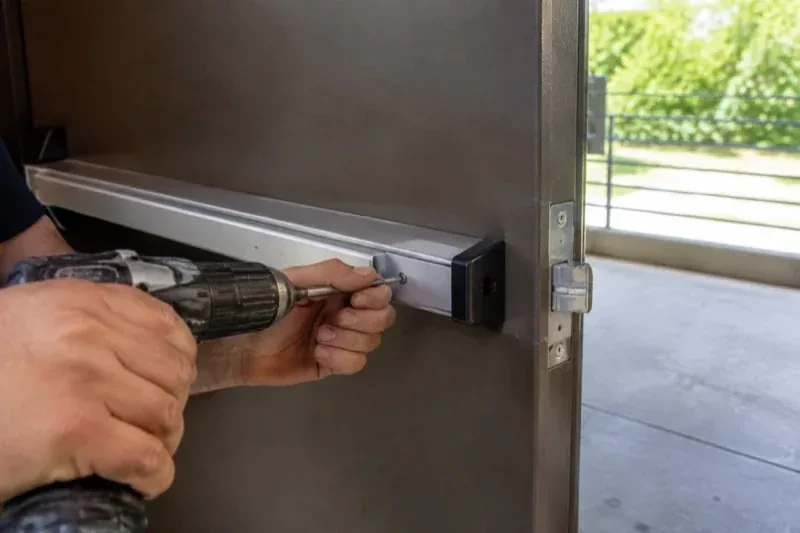
A code trigger usually starts the conversation: an occupant load over a threshold, a fire inspector's note, or a new use for a room that used to hold far fewer people. From there the visit works out which openings are affected, what device and trim suit each one, and whether a pair of doors needs a coordinator or a mullion removed. The installation follows a template, and every device is tested for release force and full latch engagement before the visit ends, with a written record of what went on the door for anyone reviewing the space afterward.
How the visit goesAfter the fit-out, the gym floor now holds more people than the old office space ever did, and the exit door at the back still has the same turn-lock it had when the room held desks.
Markham
How the visit goes
Confirming why the door needs this hardware
The visit starts with the reason exit hardware is being discussed at all: an occupant load that has crossed a threshold, a fire inspector's note, a new use for the room, or an existing device that has stopped working the way it should. Confirming this first decides everything downstream, because a door required to have a releasing device is treated differently from one where an owner simply wants easier egress. Whoever is responsible for the building is asked directly what triggered the visit, and the answer is recorded alongside the door it concerns before any hardware is chosen.
Recording what was fitted
The visit closes with a written account of the work: which device went on which door, its type and rating, the outside trim fitted, any electrified function added, and the tests the assembly passed. This record travels with the building rather than staying in the locksmith's memory, so a fire inspector, an insurer or a new manager reviewing the space later has a clear account of the exit hardware and when it was fitted.
Entry that stays separate from exit, permanently
The building keeps full control over who enters through the trim on the outside of the door, independent of what happens on the inside. A lost key, a staff change or a new access-control card affects only the entry side; the exit side keeps working exactly as it did on installation day. That separation is the point of the whole installation, and it is worth remembering when any future change is proposed for that door, so entry security is never solved by touching the inside crossbar.
Panic & Exit Hardware
In the van
- Request-to-exit switch
- Strike and reinforcement
- Signage and labels
- Outside trim (pull, lever or cylinder)
- Door closer
What affects the quote
Same fees day, night or weekend
1Number of keys or dogging cylinders
Cutting keys for the outside trim and providing a dogging key or keyed dogging cylinder for the device is counted individually, the same way any keyed hardware is.
2Signage and labelling
Any exit signage or alarm labelling the opening needs is a small addition on its own, but it is named in the quote rather than assumed to already exist on the door.
3Outside trim selected
A plain pull is the simplest outside trim. A lever with a key cylinder, or a trim matched to other hardware finishes in the building, involves more parts and more fitting time.
Panic & Exit Hardware: questions
How much force does the door need to open with?
Hardware standards set a maximum, not a target: an exit device is built to release the latch under a firm push, no more than about 15 pounds of force applied at the touchpad or crossbar, roughly the pressure of a light shove rather than a heave. That ceiling covers people who cannot lean hard into a door, so the swing stays open to anyone moving toward it under pressure.
What is the difference between a rim, mortise and vertical-rod device?
A rim device sits on the surface of the door and suits most single openings, including many tall and fire-rated doors on their own. A mortise device fits into a pocket cut in the door's edge and is chosen where a heavier case or a particular trim style is wanted. A vertical-rod device runs rods to the top, or top and bottom, of the frame, which suits an opening that specifically needs latching at more than one point rather than height by itself.
How often does this hardware need to be checked?
Fire door assemblies, including their exit hardware, are inspected and tested on a set schedule, and it is practical to check any exit device on the same rhythm even where the door is not fire-rated. A brief check for a stiff crossbar, a latch that no longer seats fully, or a strike that has drifted is enough to catch most wear before it becomes a callout.
Commercial Locks
- Master Key System DesignA dental office wants the front desk to lock up at night without ever holding a key to the room…
- Access Control InstallationThe team has grown past the point where one shared key still makes sense.
- Commercial-Grade Lock ReplacementAn inspection report flagged the rear exit as needing hardware that opens with one motion and no…
Panic & Exit Hardware near you
Below, each lock and key service we offer in Markham gets its own page, with a description that assumes no prior knowledge. Start anywhere. Many customers arrive for a lockout and leave knowing exactly why the strike plate on the back door has bothered them for years.