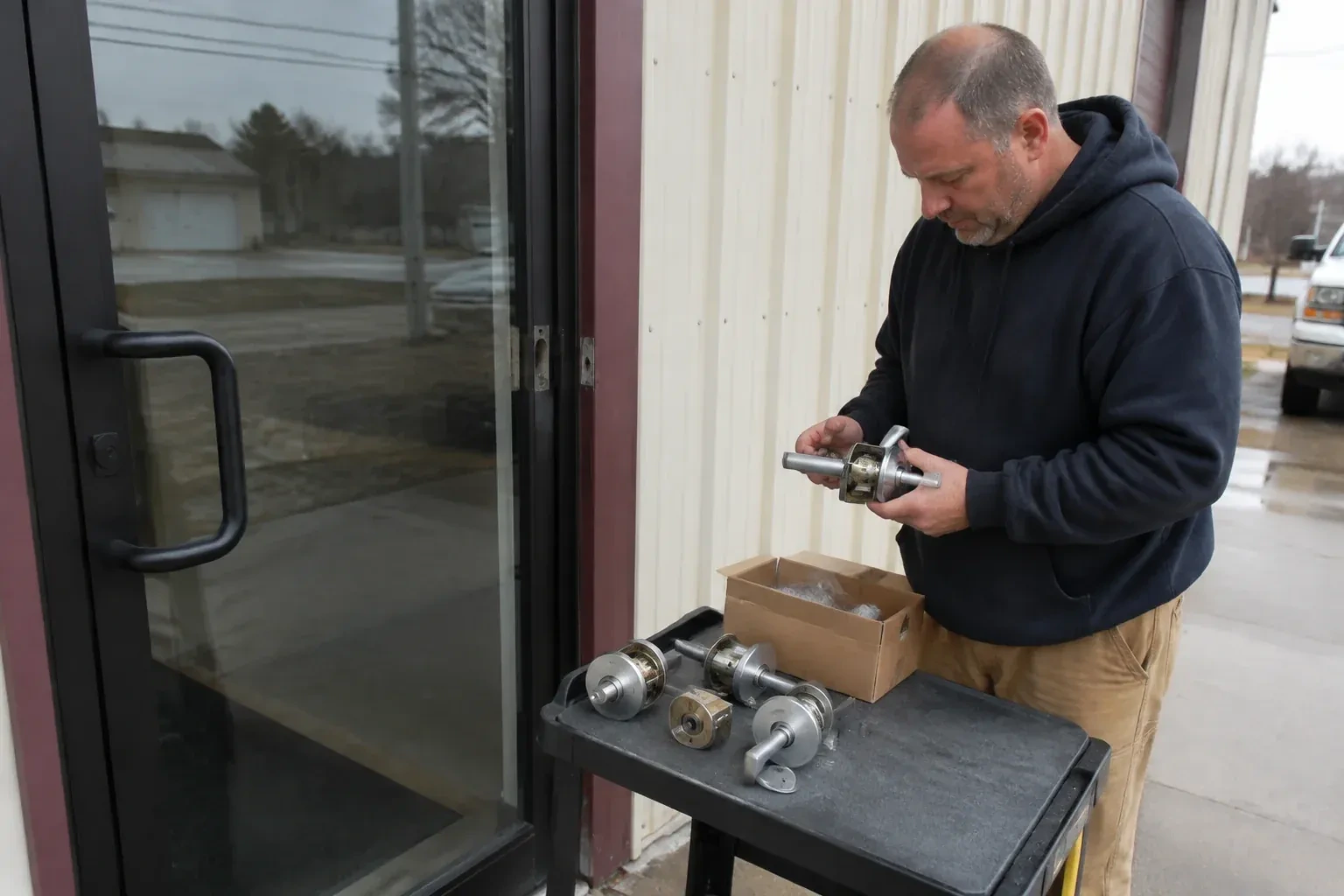
Commercial · Markham
Commercial-Grade Lock Replacement
An inspection report flagged the rear exit as needing hardware that opens with one motion and no key, and that door currently has an ordinary keyed knob on the inside.
Commercial-Grade Lock Replacement
In plain words
Think of it as re-equipping a door for the job it actually does rather than swapping one lock for a similar one. A back door taking deliveries all shift needs different internals than a quiet office entrance, and a storefront's aluminum frame needs a narrow-stile lock a wood door was never built to accept. The locksmith matches lock body, cylinder and strike to the door's real prep and real use, decides with the business whether the new hardware joins an existing master key system or starts a new one, and leaves the opening cycling cleanly from both sides before the visit ends.
How the visit goesA new tenant moved into the unit next door, and the property manager just found three different cylinders on three doors, none of them cut to the same key.
Markham
How the visit goes
Assessing damage from a break-in or forced entry
When the reason for the call is a forced door, the locksmith treats the assessment a little differently: documenting a scarred cylinder, a bent strike or a cracked frame for the business's own records or insurance purposes before removing anything. The door and frame are checked for structural damage beyond the lock itself, since a replacement lock fitted into a damaged strike pocket or a split frame will not hold the way new hardware should. Anything beyond the lock itself is noted as its own repair.
Selecting hardware built for this opening
With the assessment complete, the locksmith orders hardware to match: a mortise lock body for a mortise-prepped door, a heavy cylindrical lockset for a standard bored door, or a narrow-stile lock or hookbolt for an aluminum storefront. Where the door is part of a fire separation or a required exit, the hardware chosen is listed for that rating and function rather than a general-purpose substitute. Grade and finish are matched to the traffic the door takes, so a heavily used delivery door gets hardware built for that duty rather than the lightest option available.
A record the next contractor can use
The business keeps a plain account of what was fitted: the hardware model and function, the keying it was cut to, how many keys were issued and to whom, and any fire or exit rating the door carries. For a property manager or facilities team, this record answers the next question about that door without another site visit, and for a business with several locations it becomes a reference for bringing other branches onto the same standard over time.
Commercial-Grade Lock Replacement
In the van
- Interchangeable-core cylinder
- Mortise prep and installation tools
- Mortise lock body
- Listed panic or exit hardware
- Heavy-duty cylindrical lockset
What affects the quote
Same fees day, night or weekend
1Timing relative to a lease or renovation
Work scheduled around a tenant turnover, a renovation, or a building-wide upgrade across several units can be planned and quoted as a coordinated project rather than a series of separate calls.
2Electrified hardware and access-control integration
An electric strike, maglock or reader tie-in adds parts and testing time beyond a purely mechanical lock, and the quote separates that electrified work from the mechanical hardware so each is clear on its own.
3Restricted or patented keyways
A restricted keyway usually costs more as hardware than a standard cylinder, and duplicate keys are controlled through the manufacturer or distributor rather than cut freely; some restricted programs require formal registration, while others control the same blanks without a signed authorization step.
Commercial-Grade Lock Replacement: questions
Is panic hardware the same as fire exit hardware?
Related but not identical. Panic hardware allows single-motion release without a key on any qualifying exit door. Fire exit hardware does the same job on a door that is also part of a fire separation, and it is listed for that combined use with no mechanical hold-open feature, since a fire door has to be able to close and latch on its own at all times.
What makes a lock 'commercial-grade' rather than a residential one?
Commercial-grade hardware is built for far higher cycle counts and rougher daily handling than a home lock ever sees: heavier internal components, a lock body and strike designed to take repeated forceful use, and often a rating tied to an industry grading system that measures cycles and impact resistance. A residential deadbolt fitted to a busy business door tends to wear out well before its time because it was never built for that volume of use.
Can you upgrade hardware without re-cutting the door or frame?
In most cases, yes. Replacement hardware is chosen to fit the door's existing mortise pocket, bore pattern or narrow-stile prep, so the visit does not usually involve altering the door itself. Re-cutting only comes up when the business specifically wants to change hardware type, for example moving from a knob-and-deadbolt pair to a single mortise lock body.
Commercial Locks
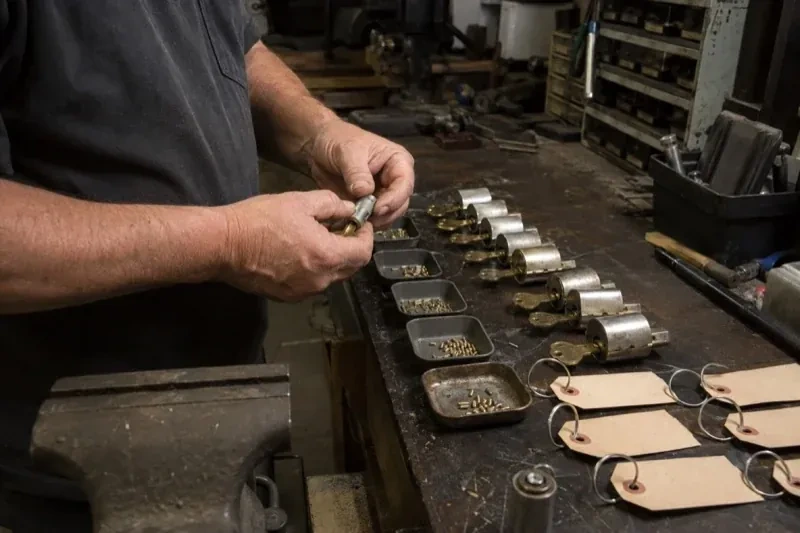
- Master Key System DesignA dental office wants the front desk to lock up at night without ever holding a key to the room…
- Access Control InstallationThe team has grown past the point where one shared key still makes sense.
- Panic & Exit HardwareTwo doors used to swing as a pair at the community hall entrance, but one leaf has started closing…
Commercial-Grade Lock Replacement near you
Below, each lock and key service we offer in Markham gets its own page, with a description that assumes no prior knowledge. Start anywhere. Many customers arrive for a lockout and leave knowing exactly why the strike plate on the back door has bothered them for years.